For HVAC/R instructors, teaching controls is about more than helping students memorize parts or follow a wiring diagram. Students need to understand what each control does, how circuits are built, and how those circuits affect the operation of a real system.
The TU-9240 HVAC Electrical Control Trainer and the TU-9250 HVAC Controls Training System from iConnect Training are both designed for students early in their HVAC/R training. However, they support different teaching goals. The TU-9240 focuses on electrical foundations and control circuit building, while the TU-9250 demonstrates the sequence of operation in a residential heating and cooling system.
The TU-9240 Builds the Electrical Foundation
The TU-9240 HVAC Electrical Control Trainer helps students learn the basics of electricity before moving into control circuit setup. Built on a rolling frame with 36 modular panels, the unit allows instructors to position 12 panels on the front display for the lesson being taught.
One of the biggest advantages of the TU-9240 is that it supports both plug-and-play wiring and direct wiring. With plug-and-play panels, students can build circuits by connecting wiring into jacks. With direct wiring panels, students cut, run, and terminate wire using terminal strips, which is closer to what they will experience in the field.
The TU-9240 uses a low-voltage 24-volt system, giving beginners a safer way to practice electrical concepts. Students can take voltage, amperage, and resistance readings while learning how series circuits, parallel circuits, relays, pressure controls, contactors, switches, thermostats, fan controls, and other HVAC industry controls function.
For programs focused on basic electricity, electrical controls, circuit construction, and component-level understanding, the TU-9240 provides a strong starting point.
 The TU-9250 Shows the System Sequence
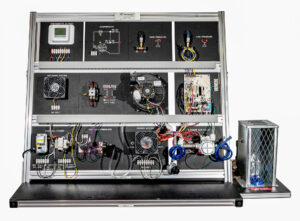
The TU-9250 HVAC Controls Training System is designed as a companion unit to the TU-9240, but its purpose is different. Instead of focusing mainly on individual control circuits, it helps instructors demonstrate the full sequence of operation for a residential heating and cooling system.
Built as a tabletop unit with 12 modular panels, the TU-9250 functions as a working model. It gives students a way to see how heating and cooling controls interact during system operation.
For the heating portion, the TU-9250 includes a working model of a furnace burner. Students can use the furnace print in the manual to direct wire the system from start to finish, helping them understand how an entire furnace system operates. The air conditioning portion is simulated with a compressor contactor, high-pressure and low-pressure controls, and a compressor panel.
This makes the TU-9250 especially useful when instructors want students to move from individual controls to the larger system picture.
The Main Difference for Instructors
A simple way to compare the two units is this: the TU-9240 helps students understand the pieces, while the TU-9250 helps students understand how those pieces work together.
The TU-9240 is ideal for teaching electrical foundations, wiring methods, control circuits, measurements, and component function. The TU-9250 is ideal for teaching residential heating and cooling sequence of operation, furnace wiring, system startup, and simulated cooling control behavior.
For many HVAC/R programs, the two units can work well together. Students can begin with the TU-9240 to build confidence with electrical controls, then move to the TU-9250 to apply that knowledge to a complete residential system model.
Choosing the Right HVAC Training Unit
The right choice depends on the course objective. If the goal is to teach how HVAC control circuits are built, tested, and understood, the TU-9240 is the stronger fit. If the goal is to show students how controls operate through a full residential heating and cooling cycle, the TU-9250 is the better match.
Both units help instructors bring HVAC controls training into the lab in a practical way. Whether a program needs electrical foundations, system sequence training, or both, iConnect Training offers hands-on equipment designed to help students build confidence early in their HVAC/R education.