
The Power of Visual Learning in HVAC/R
Trade education, especially HVAC/R, relies heavily on grasping complex mechanical concepts. Research shows that learning through visuals and hands-on experiences helps students process intricate information more effectively and apply it in real-world scenarios. HVAC systems involve internal components, airflow dynamics, and electrical circuits, elements that are often invisible to the eye. For many learners, abstract diagrams and textbook descriptions are not enough. Visual problem solvers, who need to “see” the inner workings to understand how systems function, hold a distinct advantage in the field.
Teaching Methods That Work to Bring HVAC Components into View
#1: Labs with Live Demonstrations
Hands-on labs allow students to engage directly with working systems, reinforcing both theory and muscle memory. They bridge the gap between abstract concepts and real-world operation.
 #2: Cutaway Models
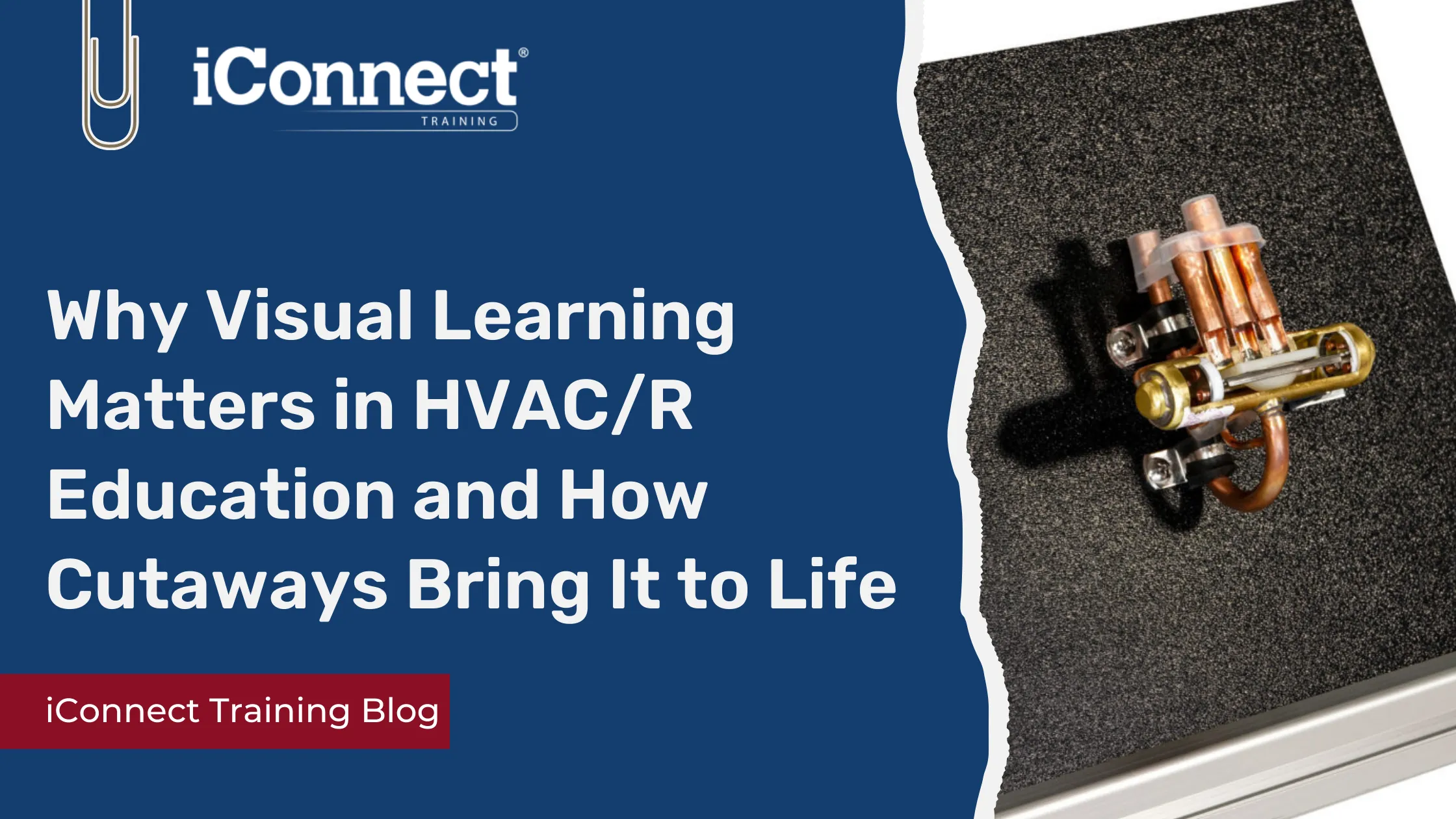
Cutaway units expose the internal structure such as motors, compressors, valves, and moisture indicators. They show how these parts interconnect and operate in real time. iConnect Training’s cutaways give teachers a powerful way to demonstrate everyday HVAC/R components from the inside out, fostering “aha” moments and durable comprehension.
#3: Tactile Learning
When students can touch, feel, and manipulate HVAC/R components, the lesson moves from abstract to concrete. Tactile learning activates multiple senses, helping students retain information more effectively and connect theory to practice. For example, handling gauges, valves, or refrigerant lines during a lesson makes the relationship between pressure, flow, and temperature far more intuitive.
How Cutaways Enhance Learning
Cutaway models serve as more than just props. They are educational anchors that elevate instruction in several ways:
Deep Understanding of Function
By observing internal mechanisms, students learn not just what a component does, but how and why it works. This understanding is vital for diagnosing and repairing systems.
Engagement and Retention
Physical, interactive models naturally draw learner attention and help encode information into long-term memory.
Consistency in Teaching
Cutaway models standardize demonstrations across multiple classes and ensure all students encounter the same high-quality instruction.
Durability for Active Classrooms
Built for the rigors of labs and vocational settings, these models are designed for heavy use and longevity.
Better Troubleshooting Skills
Seeing the inner workings equips students to anticipate how parts fail, which accelerates their diagnostic thinking.
 Quick Tips for Instructors
 Quick Tips for Instructors
#1: Introduce with Context
Start with a textbook or diagram overview, then shift to the cutaway. Once students have seen the internal layout, they can better anchor the theory.
#2: Prompt Predictive Observation
Ask students to predict the path of airflow, refrigerant, or electrical flow before showing how the internal parts interact.
#3: Encourage Sketching
Let students draw what they see inside the cutaway. This reinforces memory and helps them mentally organize component functions.
#4: Pair With Simulations
After exploring the real cutaway, have students test similar systems in a virtual simulation. Repetition across mediums strengthens learning.
Learn More About iConnect Training’s New Line of Cutaways
In HVAC/R education, visual learning is not a luxury, it is central to mastery. Whether through cutaways, dynamic labs, or simulations, making the invisible visible helps students build a mental map of system mechanics. Cutaway models, particularly those from iConnect Training, bridge abstract theory and real-world practice with clarity, durability, and engagement. For instructors crafting curriculum, pairing visual tools with hands-on and virtual experiences is a powerful recipe for deeper understanding and better-prepared technicians.
Related Articles:
Revolutionizing HVAC Education in 2024: A Classroom Preparation Guide for Instructors
How to Train Your HVAC/R Technicians with Educational Products from iConnect Training