
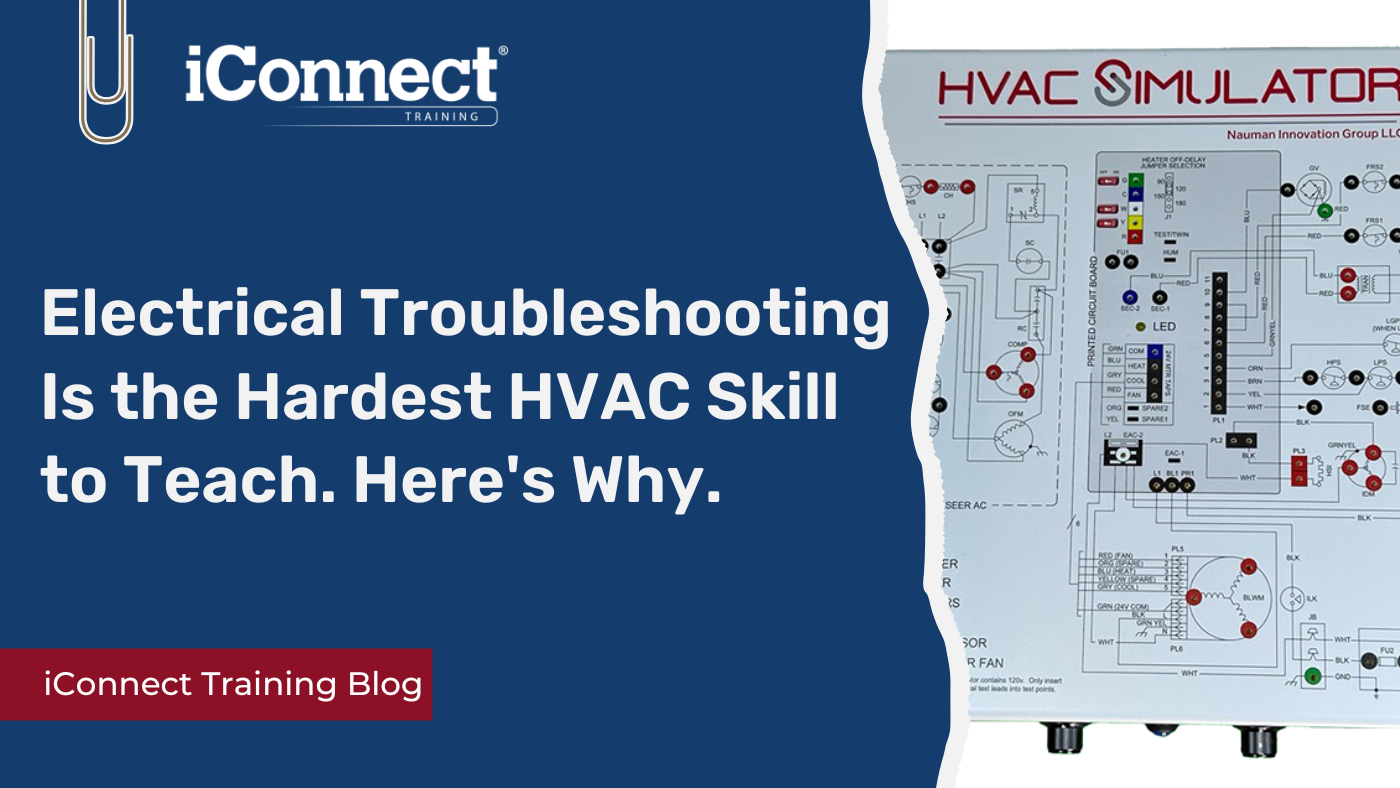
Pick up a meter after learning voltage, resistance, and sequence of operation. Seems straightforward. Then a student stands in front of a unit that won’t start and freezes. Everything they knew on paper evaporates.
That gap between theory and hands-on diagnostics is the core problem. And it’s why electrical troubleshooting takes longer to teach than almost any other HVAC skill.
Key takeaway: A student can ace every theory test and still freeze in front of a dead unit. That gap is what hands-on electrical troubleshooting training can close.
Theory Doesn’t Look Like Troubleshooting
Memorizing what a contractor does is easy. Identifying symbols on a diagram? Also easy.
Troubleshooting demands something else entirely. Students have to figure out what the system should be doing, what it’s actually doing, where the sequence died, and what measurement tells them something useful next. Each step depends on the one before it. Get one wrong and you chase ghosts through the wiring for an hour.
The real question isn’t “what part failed.” It’s “what was supposed to happen next, and why didn’t it?”
Sequence of Operation Comes First.
Students want to grab the meter and start probing. Can’t blame them. But if they don’t know what the sequence is supposed to look like, they’re guessing.
If a heating call stops mid-cycle, the first move isn’t testing the flame sensor. It’s asking: after the thermostat calls for heat, what happens next? Inducer starts. Pressure switch closes. Igniter heats. Gas valve opens. Flame establishes.
Know that chain and you can follow the circuit to wherever it broke. Skip it and you’re just touching wires and hoping.
Schematics Go From Pictures to Roadmaps
Students can point at every symbol on a schematic and still blank when they try to use one during a live diagnostic. Because a schematic on a worksheet is a reference document. A schematic during troubleshooting is a living map of current flow, and the technician has to trace it while thinking three steps ahead.
That transition from passive reading to active use takes repetition. Lots of it.
Knowing How to Use a Meter Isn’t the Same as Knowing Where to Put the Leads
Any student can learn to set a meter to voltage and touch it across two terminals. That’s the easy part.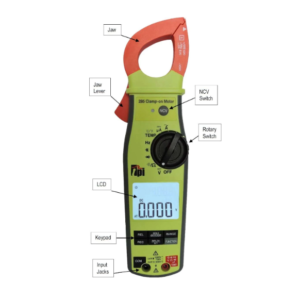
The hard part is deciding which measurement actually moves the diagnosis forward. Voltage at the contactor coil? That tells you something. Voltage at the load side of a fuse? Also tells you something. But only if you know the answer to the question before you measure.
Students have to learn to think in sequences: Is power getting to this point? Should this component be energized right now? Does this reading match what the schematic says should happen? What does that mean I test next?
Fault Simulators Make the Thinking Visible
Reading about a “bad pressure switch” in a textbook does nothing for a student’s diagnostic instincts. Give them a live circuit with a fault they have to find and suddenly everything changes.
That’s what the **CB-1212 Gas Package Unit Electrical Simulator** does. It puts **32 realistic faults** in front of students, 16 for heating and 16 for cooling. Real voltage. Real meter measurements. Real decision-making.
Students work through voltage checks, resistance readings, and microamp measurements on a system that behaves like the field. No answer sheet. No hints. Just the circuit, the meter, and whatever they know about how it’s supposed to work.
Repetition Is the Point
Solving one fault doesn’t make someone a troubleshooter. Solving ten starts to build pattern recognition. Solving fifty and they stop thinking about “what’s the answer” and start thinking about “what’s next.”
Instructors need faults they can cycle through. Different scenarios. Same fundamental process every time: know the sequence, follow the schematic, pick a measurement, read it, decide what it means, move to the next step.
The process itself becomes automatic. That’s when troubleshooting clicks.
Teaching the Process, Not the Failures
Nobody can memorize every possible failure mode across every HVAC system. That’s a losing game.
What sticks is the approach. When a student understands the sequence of operation, can navigate a schematic without help, and knows how to pick electrical measurements that actually narrow down the problem, they have something portable. Something they carry to every unit they touch in the field.
Knowing electrical theory is one thing. Walking up to a dead unit and knowing how to think through it is something else entirely.
The CB-1212 Gas Package Unit Electrical Simulator is built for exactly this kind of training. If you want your students practicing real diagnostics with live circuits and repeatable faults, it’s worth a look.