
What’s Actually Working in Today’s Classrooms
There’s a difference between how HVAC education is talked about and what actually works in the lab. The most valuable insights are coming from instructors who are teaching every day, testing ideas, and watching how students respond in real time.
Across multiple conversations, a few themes keep coming up. Not as polished takeaways, but as honest observations from people in the classroom.
They Pick Up This Stuff Like There’s Nobody’s Business
Bill Hayes, an instructor at Genesee Community College in Batavia, NY put it simply: when students are given the chance to work directly with equipment, they pick it up faster than expected.
That speed doesn’t come from simplifying the material. It comes from changing how students experience it. When they can interact with systems, follow the wiring, and connect components to outcomes, the learning process becomes more intuitive. Instead of memorizing steps, they start understanding how systems actually function.
It’s a shift from teaching what happens to showing why it happens.
See Everything in Real time
Rick Gulizia, HVAC-R Lead Instructor at Chaffey College in Rancho Cucamonga, California emphasized how important visibility is in the learning process. When students can see pressures, temperatures, humidity, and system changes in real time, the entire dynamic of the classroom changes.
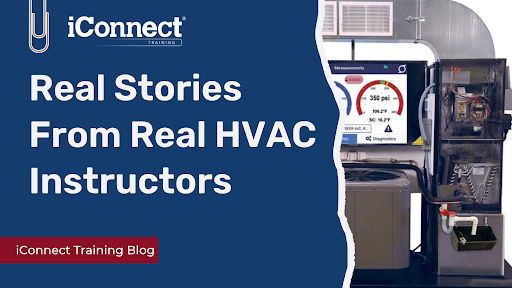
In one example, a system displayed live performance data directly on the equipment. That allowed students to immediately connect theory to what was happening in front of them. When something changed, they could see it, question it, and understand it in the moment.
For many students, especially those who are more visual or analytical, that kind of feedback makes concepts stick much faster.
If They Can Touch It, They Understand It
Hands-on learning continues to be one of the strongest drivers of engagement. Instructors consistently describe students as wanting to interact, test, and explore rather than sit back and observe.
When students are able to manipulate systems, isolate components, and troubleshoot in a controlled environment, they begin to think differently. They are no longer just following instructions. They are solving problems.
That shift is what prepares them for real-world work, where no two situations are exactly the same.
They Can Actually Troubleshoot It
Kevin Styles from HVACRVerse pointed out something that often gets overlooked in training environments. It’s one thing to explain how a system works. It’s another to let students actively troubleshoot it.
In this case, students were able to use switches tied directly to key components like contactors, reversing valves, and control boards. Instead of guessing what might be wrong, they could isolate specific parts of the system, create faults, and work through the problem step by step.
That kind of interaction changes how students think. Troubleshooting becomes a process they understand, not just a checklist they follow.
By connecting each action to a real component and a visible result, students begin to build the kind of confidence they’ll need in the field. They’re not just learning how systems operate under normal conditions. They’re learning how to respond when something goes wrong.
Hands-On Isn’t Optional
While it may not always be said this directly, it is clearly felt across every conversation. Hands-on learning is no longer a bonus. It is essential.
Students are more engaged when they are actively involved. They ask more questions, retain more information, and build confidence through experience. Instructors are seeing that when students spend more time working with equipment, they are better prepared for what comes next.
Final Thought
These are not scripted testimonials or carefully structured case studies. They are real observations from instructors who are constantly refining how they teach.
The takeaway is consistent. When students can see the system, interact with it, and understand what is happening in real time, everything changes. Learning becomes faster, more engaging, and more effective.
It’s also why more instructors are turning to solutions like iConnect Training, not as a centerpiece, but as a tool to support this style of learning. When the equipment aligns with how students actually learn, it becomes easier to create the kind of classroom experiences instructors are already working toward.